A step-by-step workbook that can help you understand your pain, rebuild trust in your body and get back to the movements you've been avoiding.
If pain has narrowed your life, so that you've started bracing before you bend or stepping back from things you used to do without a second thought, I wrote Unstuck for you. It walks you through an approach called graded exposure, a calm and practical way of helping your body and mind relearn that movement can be safe.
In South Africa the Kindle edition tends to be the quicker and cheaper option, and it reads on the free Kindle app on any phone, tablet or computer.
Or start with six free emails on why pain lingers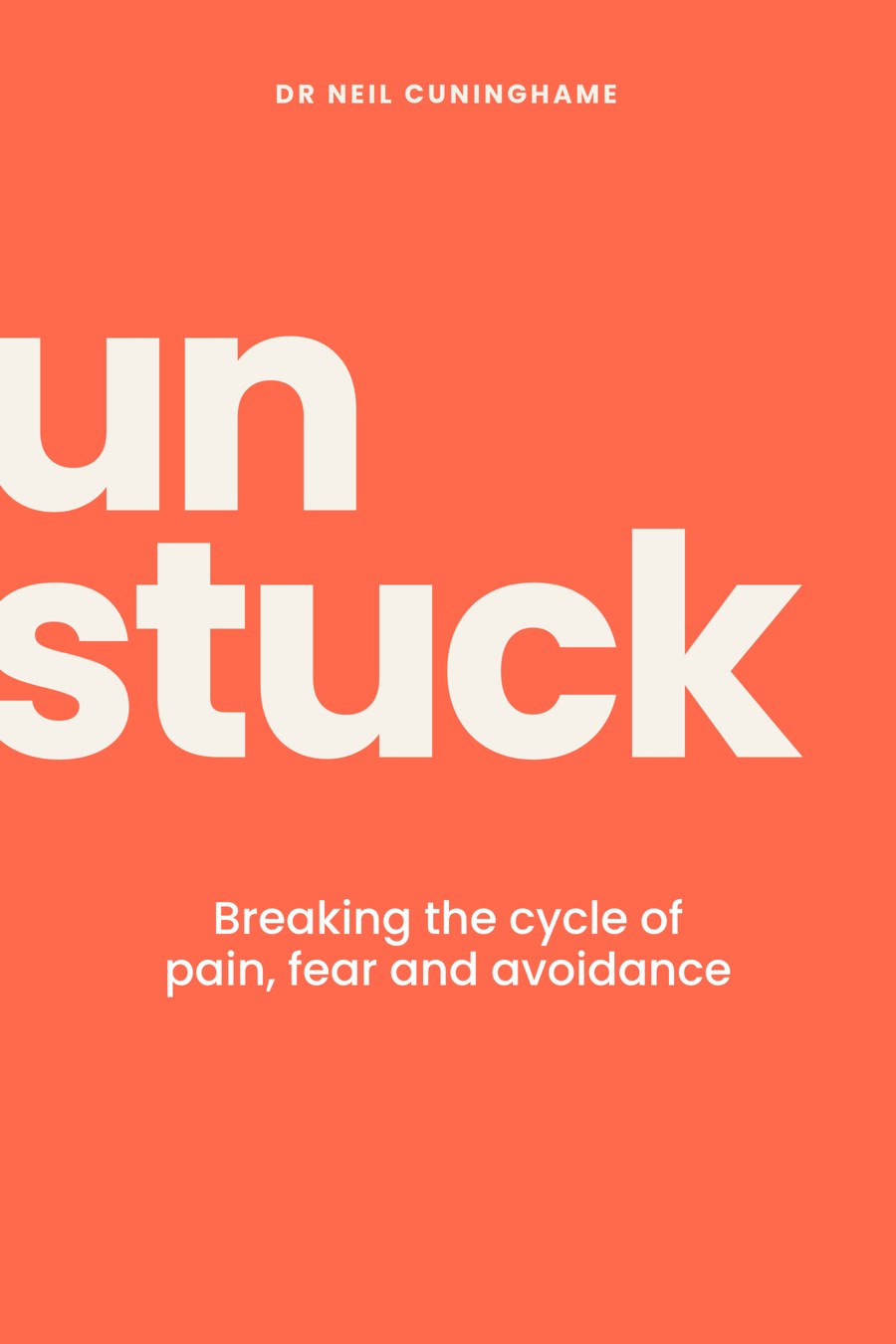
Most tissues tend to heal within a few weeks to a few months, yet pain can carry on long after that. In many cases it seems to have less to do with fresh damage than with a nervous system that has stayed on high alert, carrying on its protection well past the point it's needed. Ordinary movements can start to feel risky, so we move less, guard more and slowly cut back on what we're willing to do.
This is known as the fear-avoidance cycle, and it's one of the most common reasons I see people stay stuck instead of getting back to the life they want. Unstuck is about stepping out of that loop, one safe experience at a time.
Each safe movement can help your nervous system learn that it can ease off.
Graded exposure means going back to the movements you've come to fear in small, deliberate steps, staying with each step until your nervous system has learned it's safe and then moving on to the next.
The order of the steps is what tends to make it work. You rank them by how much hesitation each one brings up and not by how heavy or how far they are, and you begin where the fear is manageable. Each calm, safe repetition gives your nervous system a small piece of evidence that nothing bad followed. With enough of that evidence, the alarm can turn its volume down and ordinary movement starts to feel ordinary again.
The work asks for patience instead of force and moves at the pace your confidence sets, and Unstuck turns that principle into a plan you can build and follow yourself.
Underneath the ladder sit four simple steps, which give the work a shape you can come back to whenever you're unsure what to do next.
Notice the movements that raise fear, and the bracing you do without deciding to.
Break a feared activity into smaller versions, ordered from least to most daunting.
Do a step gently and repeatedly, staying within your sense of safety.
Look back at what felt manageable, and let the safe experience settle in.
If you'd like to start with the ideas behind the book, I'll send you six short emails over two weeks. They cover why pain can hang around after an injury, what your scan may and may not be telling you, the loop that keeps pain going and how to think about a flare-up. They're general education and can't assess your own situation, and you can unsubscribe at any time.
I've sent an email to the address you gave me, so please open it and click the button inside to confirm. If it hasn't arrived in a few minutes, it may have landed in your spam or promotions folder.
Unstuck is a workbook to come back to as much as a book to read. It moves from understanding to practice across nine short chapters, with reflection prompts and printable worksheets throughout.
Plain explanations of why pain can persist, why it doesn't always match what's happening in the tissues and how a sensitised nervous system can settle again over time.
Simple tools for the thoughts and feelings that travel alongside pain, including a short pause practice and a way of answering fearful thoughts with steadier ones.
The heart of the book, where you pick the activities you'd most like back, rank them by the fear they bring up and build your own ladder to climb at the pace your confidence sets.
How to tell an ordinary flare-up from a sign that needs a clinician, how to stay steady when pain resurfaces and how to keep your progress going over the long term.
Unstuck is written for people living with persistent or recurring pain who have already been checked by a clinician and would now like practical tools to rebuild movement and confidence. It tends to help most if you were active and capable and now feel cautious about going back to it, or if you've stopped doing things you enjoy in case they make the pain worse. It may also help if you find yourself bracing, guarding or holding your breath before certain movements, often without deciding to. Perhaps you've been told your scan or your body is fine and yet the pain and the worry are still there, and you'd like a clear, gentle method you can work through yourself alongside your own care.
Worked through patiently, Unstuck can help you understand your pain in a way that tends to lower fear instead of feeding it. It can help you rebuild the movements you've been avoiding, gently and in the right order, and notice progress that pain levels on their own can hide. It can also help you meet setbacks with a plan in place of panic and get back to the activities, work and people you've been missing.
Recovery rarely happens overnight or in a straight line, and what Unstuck offers is a steady, repeatable way forward that you can come back to whenever you need it.
Unstuck tends to work best alongside the care you're already getting from your doctor or the clinician treating you, and it can't diagnose your pain or replace an assessment.
Most persistent pain isn't dangerous, but a few warning signs always call for a clinician's assessment first. If your pain began after a significant accident, is steadily and rapidly worsening, wakes you night after night or comes with symptoms such as unexplained weight loss, fever or new weakness, please see a doctor before starting any self-directed movement plan. If you're ever in doubt, ask, because a good clinician would much prefer to check and reassure you than leave you waiting at home and worrying.

Dr Neil Cuninghame is a chiropractor and interdisciplinary pain practitioner in Hillcrest, KwaZulu-Natal, with more than seventeen years of clinical experience. He holds a Master's in Chiropractic from the Durban University of Technology and a Postgraduate Diploma in Interdisciplinary Pain Management from the University of Cape Town.
He wrote Unstuck after seeing the same pattern again and again in his consulting room, where bodies that had healed were being held back by a nervous system still braced for harm. The book brings the modern understanding of pain, which looks at the nervous system as well as the tissues, into a form anyone can work through at home.
Written by Dr Neil Cuninghame. MTech Chiropractic (DUT), PG Dip Interdisciplinary Pain Management (UCT).
A gradual return to feared movements in small, ordered steps, staying with each one until your nervous system learns it's safe. The steps are ranked by how much fear they bring up and not by how demanding they are, so you always start somewhere manageable.
Both. It explains how pain works in plain language and then gives you reflection prompts and printable worksheets to build and follow your own plan.
Yes. Unstuck is written for people whose pain has already been assessed, because the book can't tell you what's causing your pain and some symptoms need checking before you begin.
It's designed to sit alongside your care, and many people work through it while continuing to see the clinician treating them.
No. You work within your sense of safety, gathering calm evidence that a movement is fine, and you only move up a step once the fear has eased.
Unstuck is on Amazon in paperback and for Kindle, using the buttons on this page. In South Africa the Kindle edition tends to be quicker and cheaper, since the paperback is printed and shipped from overseas. You don't need a Kindle device, because the free Kindle app works on any phone, tablet or computer.
Paperback readers will find printable copies of every worksheet at the back of the book, and the Kindle edition links to a page where you can download the full pack.
Recovery tends to be built one manageable step at a time. You find the next rung you can manage and let your confidence grow from there, and Unstuck shows you how.
Or start with six free emails on why pain lingersFree email series
If you'd like to start with the ideas behind the book, I'll send you six short emails over two weeks. They're general education and you can unsubscribe at any time.